🎯 Properly localized campaigns increase conversions. Localize your content into any European language.   FREE CONSULTATION

FREE CONSULTATION

Psychology in e-commerce: what aftercare service Germans and Hungarians expect

Published
12/19/2025
Reading in
6 minute

When expanding abroad, brands that understand local customer habits are most successful, as customer expectations can vary significantly from country to country. Sophisticated adaptation of after-sales services, communication, and return processes not only eliminates the risk of errors but also builds lasting customer relationships.

In this article, we will use Hungary and Germany as examples to show you how to create a cross-border CX that works.

Expanding abroad is not just about translating a website or signing a contract with a courier service.

The real challenge begins after the sale itself – in the area of customer service. Germans, who represent the mature and formal DACH market, have completely different expectations than Hungarians, who value personal contact and flexibility typical of Central and Eastern European markets. Effective after-sales service requires an understanding of these cultural differences.

A single universal CX model used everywhere is the easiest way to lose margins and reputation today.


Formal versus friendly - differences in communication tone


The biggest differences between the DACH and CEE markets are evident in the very nature of communication:

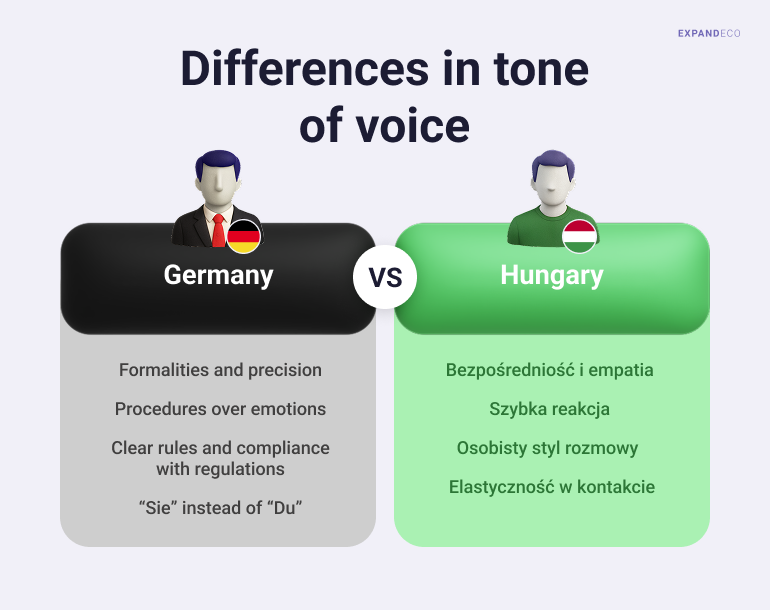
🇩🇪 Germany: precision and adherence to rules

German customers expect reliability, clear procedures, and compliance with regulations. Communication should be formal, factual, and precise. According to a CX survey, consumers in Germany are less interested in the emotional aspect—they are primarily interested in specific information and timeliness.

Using overly informal forms of address, such as "Du" instead of "Sie," or inaccurate descriptions of returns can undermine the professionalism of the entire transaction.

🇭🇺 Hungary: speed and personal contact

Hungarians, like other customers from Central and Eastern Europe, value empathy and direct contact more than formal procedures. What is important is the speed of response and the impression that they are communicating with someone who really understands their problem.


What is perceived as professionalism and seriousness in Germany may be perceived as a reserved approach in CEE countries. Therefore, it is crucial for effective CX today to adapt the tone of communication—from polite formality to an emotional style of conversation. Customers want to feel that the brand speaks their language, not only literally but also culturally.

Natalia Leonard - Marketing & Operations Manager @ Expandeco Polska

Our customer service teams are able to adapt to these two extremes. Thanks to language audits and support from native speakers, communication is completely tailored: formal and precise in Germany, and fast and empathetic in Hungary.


Phone versus email - different communication preferences


Preferences for contact channels have a direct impact on the organization of the customer center.

🇩🇪 Germany: written form and order

Germans prefer email as their main contact channel – it gives them a sense of control and leaves a record. The telephone is seen as a last resort when other methods fail. Customers in Germany also like to use FAQs and chatbots – they welcome independent problem solving where they don't have to contact an e-shop representative.

🇭🇺 Hungary: instant conversation

Hungarians, on the other hand, are more likely to call. They value immediate responses and problem resolution on first contact. In CX reports for the Central and Eastern European region, the phone and social media are identified as the channels where customers expect the fastest response.
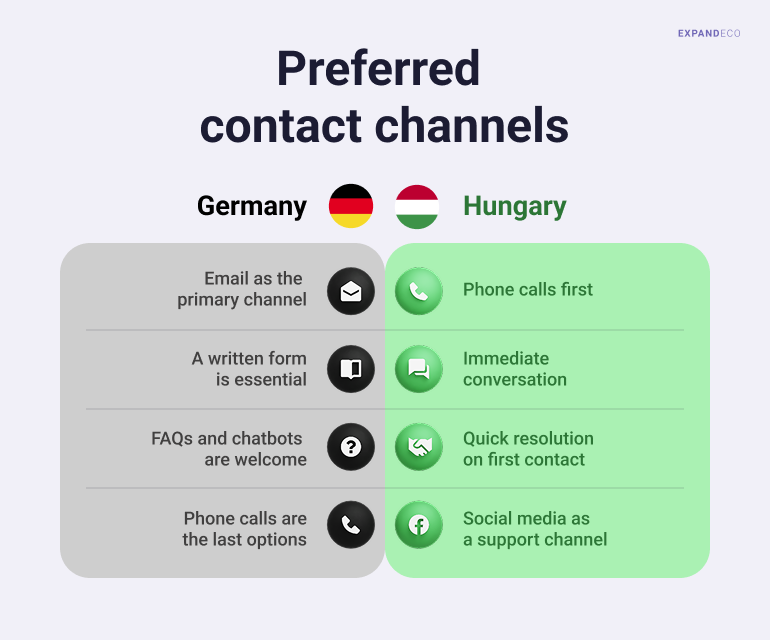


By introducing local phone numbers in Germany and Hungary, you can tailor your services to both models:

✅ In Germany, you provide a sense of accessibility and security.
✅ In Hungary, you provide speed and the convenience of conversation in the native language, which directly influences satisfaction and repeat purchases.


Returns as a right vs. returns as a benefit – different expectations in logistics


Returning goods is one of the most costly and sensitive parts of e-commerce.

🇩🇪 Germany: a flawless and compatible process

For Germans, the right to return goods within 14 days is an inviolable standard. They expect a transparent process, confirmation at every stage, and a timely refund. Any deviation from the procedure can undermine trust in the brand.

🇭🇺 Hungary: speed of refunds is what matters

In Hungary, the speed of fund transfers is key—delays immediately cause frustration. Research shows that for many customers in Central and Eastern Europe, the speed of refunds is a decisive factor in repeat purchases.
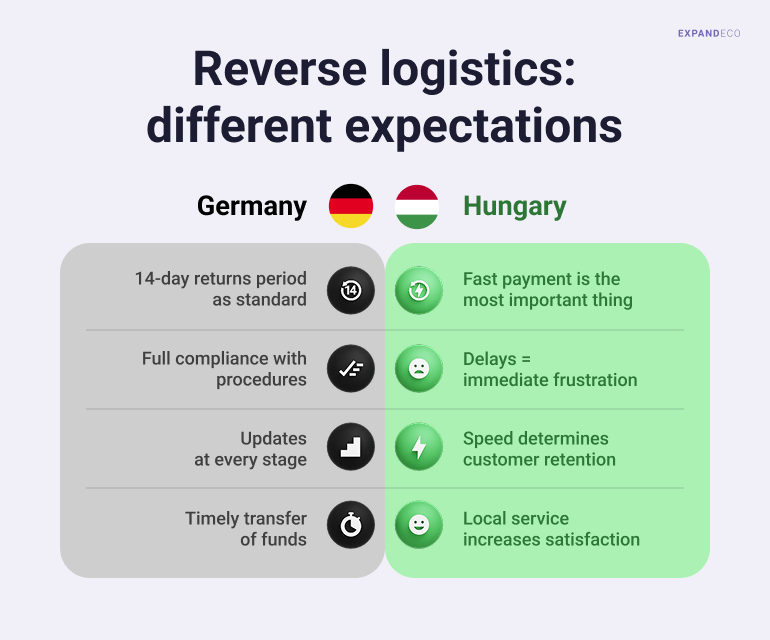

 

From the customer's point of view, returning goods is no longer the end of the transaction – it is part of the overall shopping experience. If this process is simple and local, consumers not only return goods, but also recommend the store to others. In practice, reverse logistics is increasingly influencing conversion and loyalty, especially in foreign markets.

Bartłomiej Waluś - Head of Sales @ Expandeco Polska

The implementation of local addresses for returns and bank accounts in EUR and HUF shortens the logistics process and enables immediate processing of returned goods – in line with German precision and Hungarian expectations of speed.

Local foundation of trust

Effective after-sales service is not possible without a local presence. German customers will not trust a company without a local address or telephone number. Hungarian buyers will also refrain from purchasing if they are not sure that they can rely on real support in case of a problem.

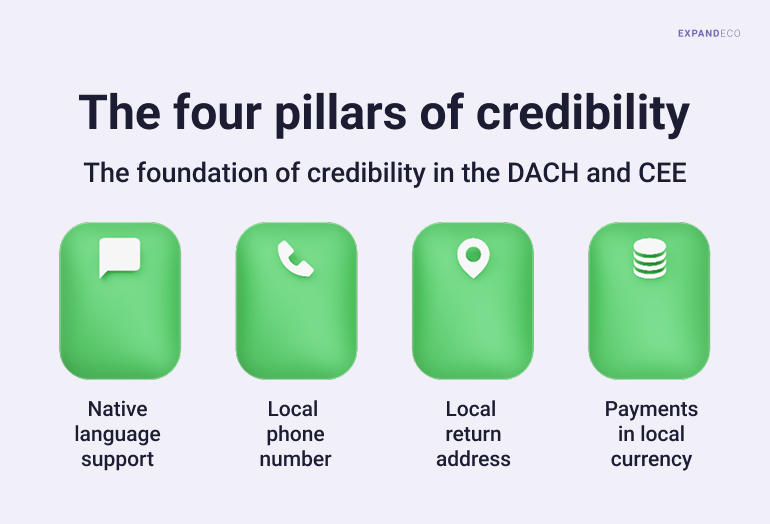
Therefore, a solid foundation for service is the native language, a local phone number, a local address for returns, and payments in local currency. These four elements are the pillars of trust that customers intuitively perceive – even before they place an order.


Summary


Success in customer support in the DACH or CEE markets depends on flexibility. With Germans, you need to be precise and formal, while with Hungarians, you need to be quick and empathetic.

This requires a multi-channel, native CX structure based on local resources and an understanding of cultural nuances. With this approach, after-sales service becomes not just a cost, but a strategic tool for building competitive advantage.

Are you interested in growing in one of these countries?

Schedule a free consultation and we'll tell you where we can support your expansion!

Next article

Register to receive new articles at your email.

You may be interested

Attract Italian and Greek Customers. Returning goods can be to your advantage!

Attract Italian and Greek Customers. Returning goods can be to your advantage!

A boot-shaped country is not very logistically advantageous for European online shops. Deliveries are thus complicated by the less accessible Southern Italy. The Greeks, on the other hand, with their “tomorrow is also a day” attitude, are not very bothered about the delivery speed of parcels. However, Southern European customers, as in other countries, are demanding in terms of service, demanding hassle-free returns, and the quickest possible resolution of their complaints. This is what can be solved without compromise by collection points abroad.
 

Read
How much does expansion cost: Accounting governance, the legal framework for business and logistics V.

How much does expansion cost: Accounting governance, the legal framework for business and logistics V.

In the previous part of our series on expansion costs, we focused on the costs associated with customer support, when you should build your own team and, on the contrary, when to use the services of an agency. In this part, fifth one already, you will find out what to keep in mind when managing accounting, how to guard the business rights of a given state and how important role does the reverse logistics play in the expansion of e-shop.
 

Read
How much does expansion cost: What and how much will you pay for once you're in the market? IV.

How much does expansion cost: What and how much will you pay for once you're in the market? IV.

If you have successfully penetrated a new market, congratulations. And now a helping hand! Only now comes the daily repetitive grunt work that will propel you to success abroad. What activities to focus on? How much will it cost you? How do you decide which option is right for you? This time we focused on the costs related to customer support, how to improve it with a minimum of costs, when to outsource it and when, on the contrary, to build your own team.
 

Read
Welcome! Do you agree with the loading of cookies?

Before you enter our online world, we would like to ask you to store cookies in your browser. Your consent helps us to flawlessly display the site measure its performance or statistics, and be a better partner in your business. We also provide cookies to our verified third parties, which we list in Personal Data Protection. Your data is as secure with us as it is with the provision of our services.